Human language that fits the source
Where a term or audience is genuinely broader than men alone, the English should not sound narrower than the source. Where the source is male-specific, we keep it male-specific.
The Founding 30 is the first working group around the next phase of Bible With Original Names: thirty people reading closely, comparing sources and translations, testing the reader, and bringing the questions that make the work better.
No credential requirement. No agreement on every interpretation required. Curiosity, care, and a willingness to show your work matter more.
The print edition and digital reader give us a real starting point. They are not the end of the work. The move from Edition 1.1 toward Edition 2 is an opportunity to read the whole project with greater discipline: where does the English narrow the source unnecessarily, where has a word been flattened, where do original names change the way a passage is heard, and where does the reading experience itself get in the way?
The Founding 30 exists to make that review conversational and accountable. We want people who will say, “This works,” “This does not,” “Show me the Hebrew,” “What does the Greek actually allow?”, “What happens in the Aramaic tradition?”, or simply, “I read this twice and it still does not sound like a human sentence.” All of those are useful forms of attention.
Where a term or audience is genuinely broader than men alone, the English should not sound narrower than the source. Where the source is male-specific, we keep it male-specific.
One source word can carry different senses in different passages. We would rather render harm, wrongdoing, misfortune, deceit, calamity, or another precise sense than force one English abstraction everywhere.
Yeshua, YHWH, Elohim, Ruach, Moshe, Kepha, Maryam, Dawid, and other historical forms keep people, places, and relationships closer to their own linguistic world.
The text also lives in a web and mobile reader. Search, pronunciation, original-name guides, sharing, navigation, accessibility, and updates should make close reading easier, not harder.
We are not trying to make thirty people think the same way. We are trying to make claims that can survive questions, evidence, disagreement, and another careful read.
That does not mean biblical Hebrew and Greek are ungendered languages. They are not. It means grammatical form, social convention, and actual referent are not always the same thing.
For example, the Greek plural adelphoi is morphologically masculine and is often translated “brothers,” yet it can address a mixed community of women and men. Even the ESV’s own preface notes that adelphoi was often used in Greek for both men and women. In Hebrew, adam can be a particular person in one context and humanity more broadly in another; Genesis itself can use the term for humanity described as male and female.
That distinction matters for readers who have spent years hearing English that can sound as though Scripture is speaking mainly to men. Sometimes a passage really is about a man, a son, a husband, a father, or a king. Sometimes it is not. The work is to tell the difference rather than assume it.
A useful New Testament example of why context matters. A masculine plural family term can address an entire congregation, including women. This is not a novel claim unique to this project; major translation traditions explicitly discuss it.
Read the ESV preface discussion ↗A Hebrew term that can name an individual or speak more broadly of the human being / humanity depending on context. Genesis 1:26–27 is a clear place where humanity is then described as male and female.
See a Hebrew-text discussion ↗The Hebrew Bible begins with Hebrew and Aramaic evidence. The New Testament begins with its Greek text. From there, Semitic setting, Aramaic language and traditions, manuscript history, lexicons, ancient translations, and later translation history can all sharpen the question we are asking.
Aramaic context is not a shortcut around the Greek text, and a lexicon is not a machine that chooses an English word for us. These sources are part of a larger conversation about what a sentence could mean, what it likely meant in context, and how much of that can responsibly be carried into English.
The same principle applies to familiar religious vocabulary. A traditional rendering may be good, beautiful, and deeply rooted. It may also have become so familiar that readers no longer hear the range behind it. We want room to ask what is gained or lost without treating inherited English as either untouchable or disposable.
That is the posture of this group: source first, history taken seriously, familiar translations respected, and every proposed change open to challenge.
These are not slogans for a translation philosophy. They are examples of the kind of sentence-level decisions the group can examine.
“There is a misfortune I have seen under the sun, and it weighs heavily on humanity:”
Here the English does not turn a broad human observation into a statement that sounds limited to men.
“Put away the harm of your doings from before my eyes. Cease doing harm.”
A concrete moral verb can be clearer than an abstract catch-all when the Hebrew context is about harmful or evil action.
“The scroll of the generations of Yeshua the Messiah, son of Dawid, son of Avraham.”
Original-name forms can change the mental map of a familiar passage without changing who the people are.
Scripture quotations from The Way Version of the Living Word, copyright © 2026 The Way Partners LLC. Used by permission. All rights reserved.
You do not need to abandon the King James Version, ESV, NRSV, NIV, or the translation you normally use. Comparison is part of the point. We recommend beginning in wisdom literature because the language becomes practical very quickly.
Start with the wording already in your head. Notice what you assume before comparing anything.
Read the same chapter again. Mark names, pronouns, repeated words, and sentences that feel meaningfully different.
Tap original-name guides, search other occurrences, listen to pronunciation, and test the web or mobile experience as you go.
Share what you found with the group—agreement, disagreement, source evidence, or simply a passage worth sitting with.
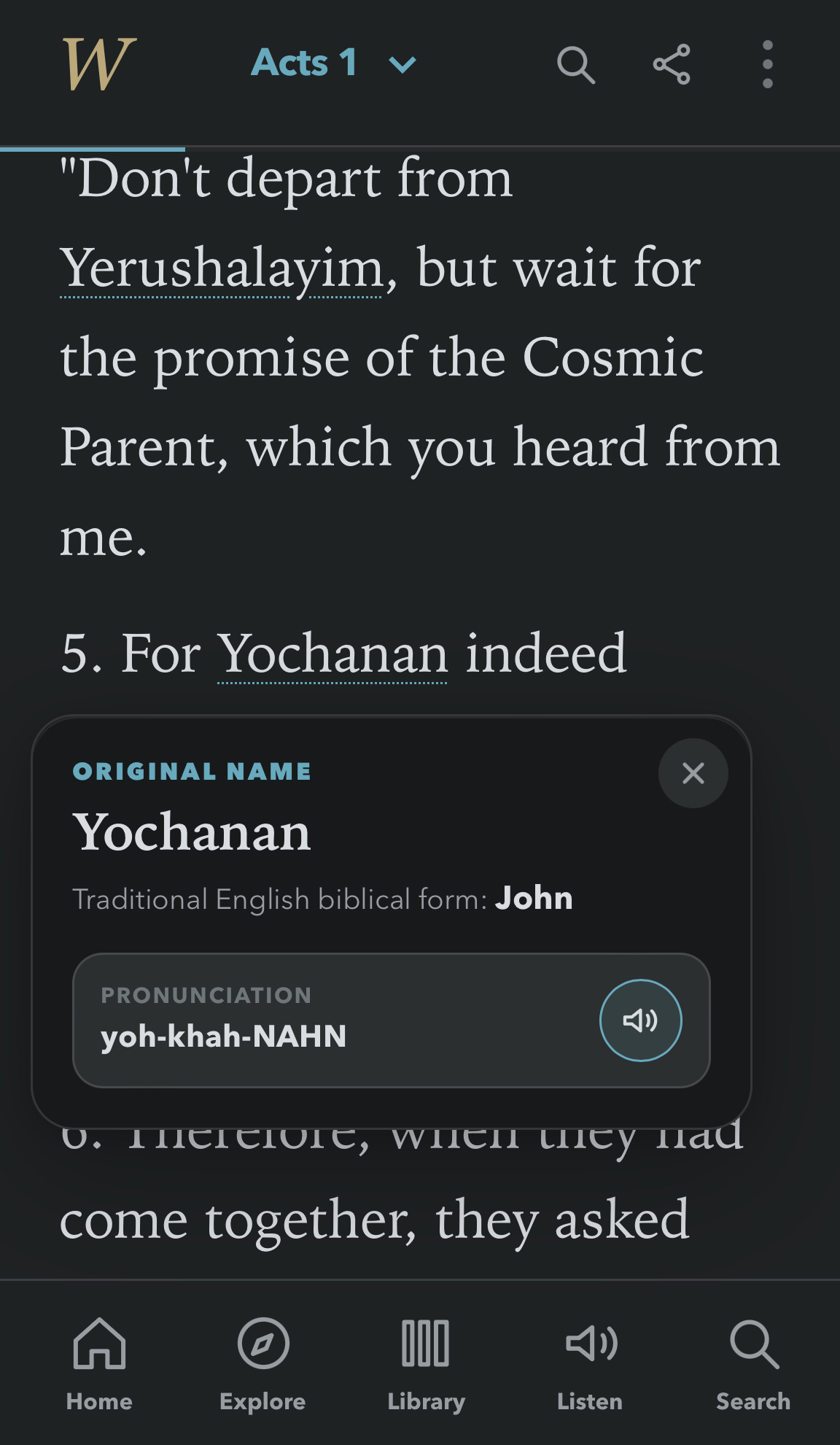
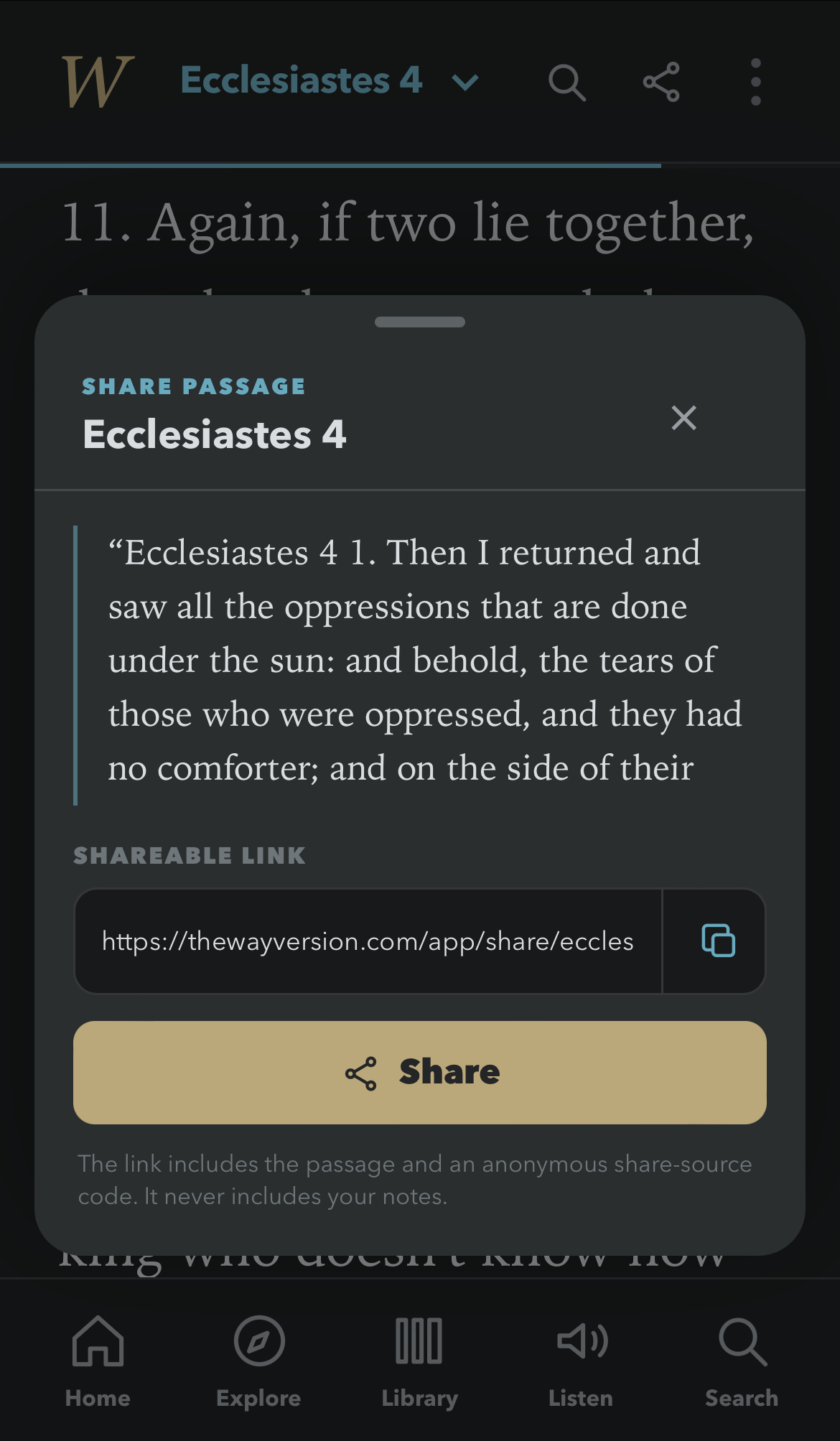
Edition 2 is not only a set of translation decisions. The web and mobile experience affects whether people actually read, compare, return, share, listen, take notes, and discover why a name or phrase matters.
Founding 30 participants can report friction, test new reading flows, identify accessibility problems, suggest better explanations, and help us separate features that genuinely support Scripture reading from features that merely add noise.
The strongest group will not be thirty copies of the same person.
This is a discussion group with a working purpose, not a doctrinal exam.
The Way Partners LLC is working to grow this project into something that can sustain serious research, editing, publishing, software, community work, and—where resources allow—paid and full-time roles.
The Founding 30 can help us understand what those functions should be and what kind of organization this work needs. Some people may eventually want to pursue deeper or professional involvement. We want that possibility to be real rather than implied.
“To you, people, I call! I send my voice to all humanity.”
“Blessed is the one who hears me, watching daily at my gates, waiting at my door posts. For whoever finds me, finds life…”
We think there is a strong starting point. We also think the next edition gets better when people who care about the text are willing to read it closely together. If that sounds like work you want to be part of, join the conversation.
About the name “Founding 30.” Founding 30 is a community and working-group name for this stage of the mission. Participation does not make a participant a founder or co-founder of The Way Partners LLC or of any related project or entity, and it does not create a partnership, membership interest, equity or ownership interest, employment or contractor relationship, agency or fiduciary relationship, governance right, revenue-sharing right, intellectual-property right, securities interest, or right to compensation.
Any future employment, paid engagement, ownership, license, governance role, or other formal relationship would require a separate written agreement. Participation is voluntary, may end at any time, and participants speak for themselves unless expressly authorized otherwise. Nothing on this page is an offer of securities or a promise of employment or compensation.