Repent — or turn back?
“Repent: for the kingdom of heaven is at hand.”
“Turn back, for the reign of the heavens has drawn near.”
If you still want the Bible but keep getting pulled out of the text by inherited religious wording, The Way Version gives you another way in. It is a complete free Bible with Yeshua and YHWH visible, context-sensitive English, and interpretive choices labeled instead of hidden.
I’ll send the Bible and the links you need to read it on your phone, browser, or e-reader.
Free. No purchase required. Unsubscribe anytime.
You do not have to agree with every choice. Put it beside the Bible you already use and decide passage by passage.
The Way Version has all 66 books and 1,189 chapters. You can read it straight through. The differences are in how it handles names, recurring translation decisions, gendered English, and selected passages where the edition deliberately opens a resonance layer.
YHWH, Elohim, Ruach, Maryam, Yochanan, Dawid and other selected forms remain visible so the ancient setting does not disappear completely into later English names.
Actual men remain men. But a general human term does not need to become “man,” and a mixed congregation does not need to sound male-only just because older English worked that way.
John 14:6’s living-way language is an interpretive resonance expansion. The project documents that instead of claiming the added English is a lost literal manuscript reading.
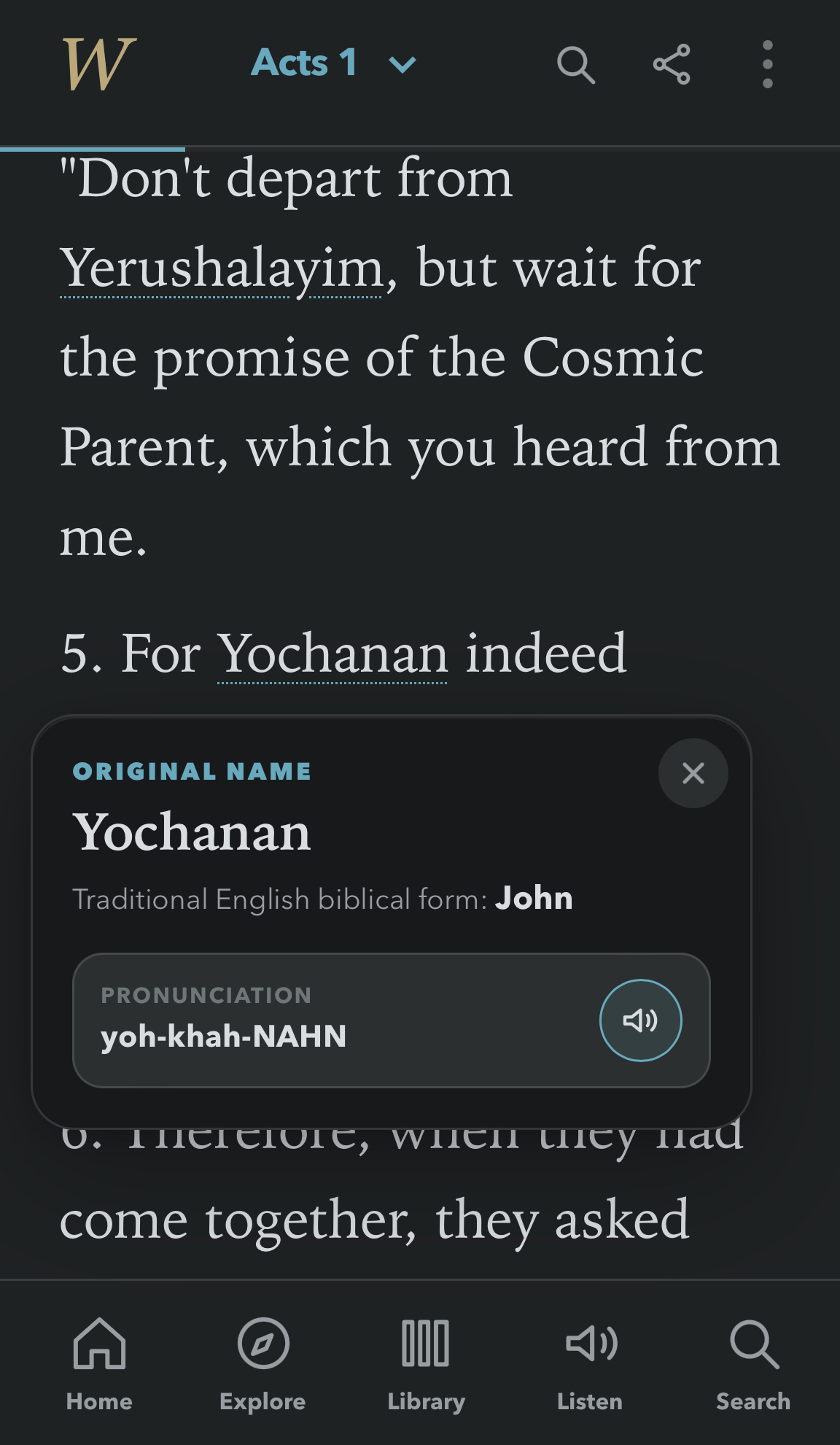
In the reader, original names are not just decoration. Tap one and you can see the familiar English form and pronunciation. You can also switch the reader between original-name and traditional-name display without changing the canonical Bible text underneath.
“The scroll of the generations of the Messiah, son of Dawid, son of Avraham.”

That distinction is the whole point. The Way keeps sex-specific people and language when the source is actually specific. It pushes back when English tradition can narrow a mixed group, minimize a woman’s role, or treat a masculine divine pronoun as mandatory English theology.
The current Way text says, “Phoebe our sister, who is a deacon…” NIV 2011 and NRSVue make the same main-text choice. ESV chooses “servant,” with a deacon/deaconess alternative in its notes.
The Way preserves the grammatical flow: “submitting yourselves to one another in reverence for the Messiah: wives, to your own husbands…” It does not delete the household passage; it refuses to start the sentence one verse too late.
The current Way text reads, “Likewise, the women must be reverent…” rather than automatically deciding the line means only wives of male servants.
Maybe you are not done with Scripture. Maybe you are done arguing with the English every few verses.
The Way is trying to reduce that friction without asking you to stop thinking, stop comparing, or stop noticing where the translators themselves are making an interpretive call.
NIV 2011 regularly uses inclusive contemporary English for mixed groups. NRSVue makes inclusive human language part of a scholarly revision method. ESV preserves more traditional grammatical form. The Way overlaps with each in places—and then adds original-name restoration, public change history, and a more explicit resonance layer.
Beautiful, influential, public-domain language—but some words and male-generic conventions no longer land in modern English the way they once did.
An “essentially literal” approach that preserves more traditional grammar and theological vocabulary, even where the modern reader has to do more interpretive work.
More willing to say “brothers and sisters,” “people,” or singular “they” when translators judge that contemporary English better communicates the original scope.
Original names, contextual lexical review, public revision history, and visible separation between source-near translation and spiritual resonance.
Do not decide from the marketing. Compare it. Tap the names. Read the verse before and after the one that surprised you.
The Bible and reading links will go to your inbox.
Free. No purchase required. Unsubscribe anytime.