“The LORD” is already a translation decision.
“The LORD is my shepherd…”
“YHWH is my shepherd: I shall lack nothing.”
The manuscripts do not arrive in English. Every Bible has to decide how to render names, idioms, titles, gender, and loaded words. The Way Version keeps more of those decisions visible so you can compare the text instead of pretending the choices are not there.
I’ll send the Bible and the reading links. You can also open it immediately without signing up.
Free. No purchase required. Unsubscribe anytime.
This is not a ranking. It is a map of the tradeoffs a reader is already encountering.
Crossway describes the ESV as “essentially literal.” It keeps more traditional grammar, metaphor and theological vocabulary, which can preserve structure but ask more of a modern reader.
Official philosophy ↗The NIV balances transparency to the original with contemporary clarity. Its 2011 revision used a large corpus of modern English to inform choices such as mixed-gender address and singular “they.”
Official process ↗The NRSVue incorporates newer manuscript and philological work while explicitly aiming for clear, direct and inclusive English in a scholarly/ecumenical tradition.
Official overview ↗The Way adds original names, contextual lexical review, a public change history and selected resonance readings that are supposed to be distinguishable from source-near translation.
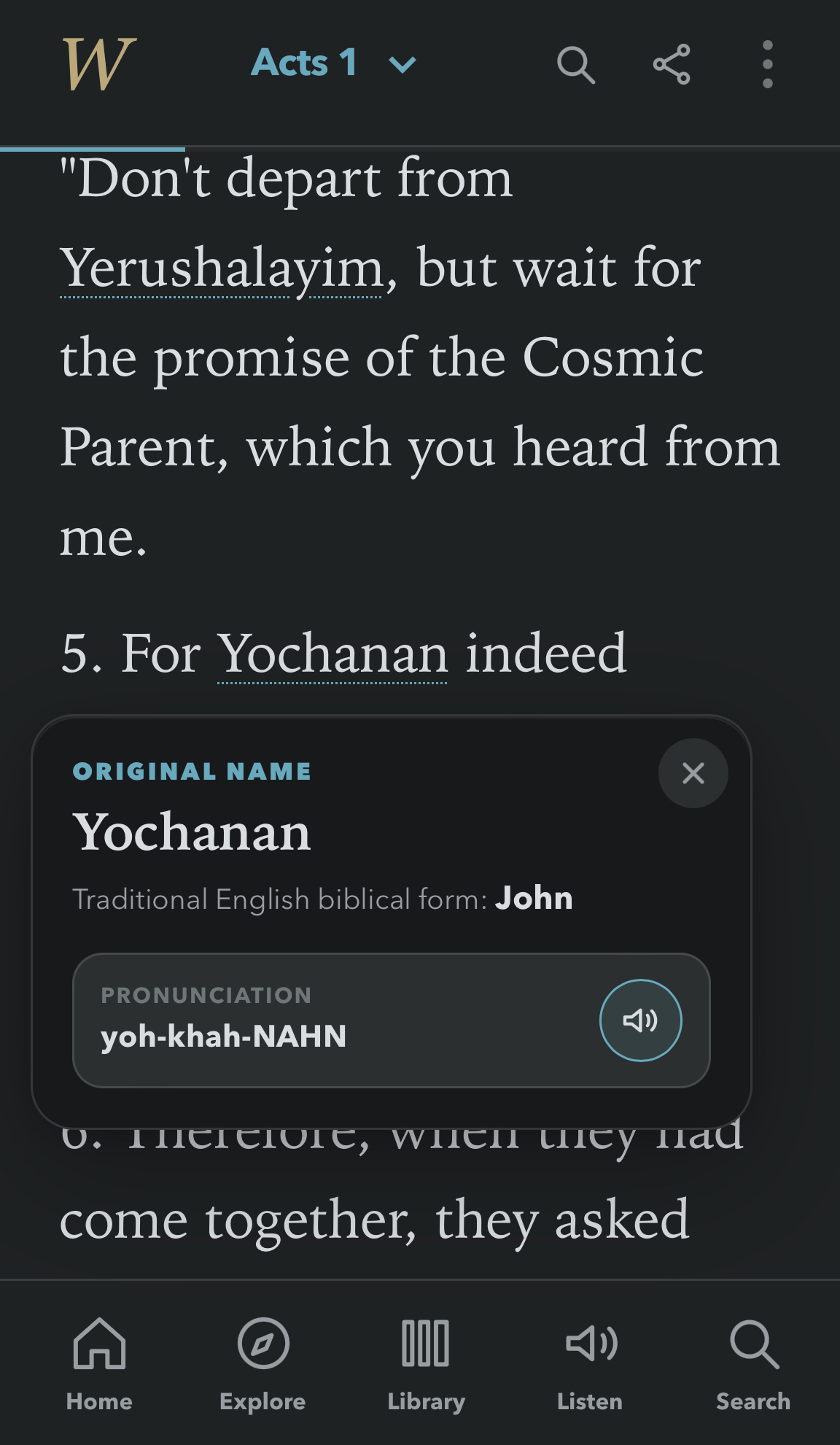
Read The Making →Tap an original name in the reader to see the familiar English equivalent and pronunciation. Or switch the whole reader to traditional-name display. The canonical text stays the same underneath, so highlights and shares remain stable.
“Behold, you will conceive… and will call his name .”

Neil Douglas-Klotz is useful here because his Aramaic/Syriac work asks a different question from a conventional critical translation. He pays unusual attention to root-fields, repetition, sound, breath, bodily imagery and several possible hearings of one Semitic phrase.
The Greek uses definite articles. The word “only” is not inserted before “way”; the restrictive force comes from the clause that follows.
Syriac grammar does not map one-for-one onto English articles or the verb “to be.” That creates texture, but it does not mechanically prove that English must say “a way.”
Douglas-Klotz gives interpretive weight to repeated sound and semantic range. The Way’s “living way” / alignment wording belongs to this interpretive layer, not to a claim of a lost word-for-word manuscript.
Lexical meaning, grammar, context, textual witnesses and social setting.
Choosing among legitimate senses, resolving idiom, deciding how much context English must make explicit.
Sound, association, contemplative expansion and embodied hearing—valuable when identified, misleading when disguised as dictionary certainty.
Read Psalm 23. Matthew 5. Romans 16. Or a passage you memorized years ago. You will notice very quickly whether seeing the translation choices helps.
The Bible and reading links will go to your inbox.
Free. No purchase required. Unsubscribe anytime.